Ch2. Basic Graph Algorithms
Graph
We use \(G = (V, E)\) to simply describe a graph.
- \(V\): set of vertices (nodes)
- \(E\): pairwise relationships among \(V\)
Accordingly:
- \(n\): number of vertices
- \(m\): number of edges
- usually \(n - 1 \leq m \leq n(n-1)/2\)
- for connected simple graph (without multi-edges)
- \(d_{v}\): number of neighbors of \(v\)
We can use "Adjacency Matrix" or "Linked Lists" to store a graph.
- Adjacency Matrix: a \(n\times n\) matrix, \(A[u, v] = 0\) i.f.f. \((u, v) \not\in E\), else \(A[u, v] = \text{weigh}(u, v)\)
- Linked Lists: for every \(v\), there is a linked list containing all neighbours of \(v\)
| Matrix | Linked Lists | |
|---|---|---|
| memory usage | \(O(n^{2})\) | \(O(m)\) |
| time to check $ (u,v) ∈ E$ | \(O(1)\) | \(O(d_{u})\) |
| time to list \(v\) neighbors | \(O(n)\) | \(O(d_{v})\) |
Connectivity && Traversal
We can use BFS or DFS to traverse a graph, and check its connectivity.
1 2 3 | |
| BFS | |
|---|---|
1 2 3 4 5 6 7 8 | |
| DFS | |
|---|---|
1 2 3 4 5 6 7 8 9 | |
Both BFS and DFS costs \(O(n + m)\) time and \(O(n)\) space.
Bipartiteness
A graph $ G = (V, E) $ is a bipartite graph (二分图) if there is a partition of $ V $ into two sets $ L $ and $ R $ such that for every edge $ (u, v) \in E $, we have either $ u \in L, v \in R $ or $ v \in L, u \in R $.
That is, you can color all vertices using only two colors such that no two adjacent vertices share the same color.
So we can traverse the graph. For \(u\)'s neighbor \(v\), if it is uncolored, color it with opposite color to \(u\). If it is colored, and has the same color of \(u\), then stop the traversal, confirm the graph is not bipartite. If the traversal finishes without conflict, the graph is bipartite.
BFS is a better choice than DFS, because BFS traverses the graph level by level, where vertices in the same level share the same color, and vertices in adjacent levels have different colors.
Topological Ordering
For a DAG (directed acyclic graph), we can always find an order, where if \((u, v) \in E\) then \(u\) appears before \(v\) in that order. We call this order "Topological Order".
We use Kahn Algorithm to construct a topological order. By the way, it can check if a graph is a DAG as well.
| Toposort | |
|---|---|
1 2 3 4 5 6 7 8 9 10 11 12 13 14 | |
S can be represented using a queue or a stack.
Running time = \(O(n+m)\), as every vertice and edge need to be processed once.
DFS tree
Consider a DFS tree of a connected graph. Take directed DFS tree as an example.
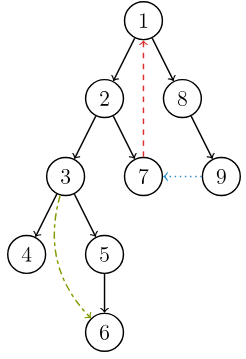
We can classify the graph edges to four types:
- Tree edge, which contributes to the DFS tree. (Otherwise the edge are not in the DFS tree)
- Back edge, which goes from child node to ancestor node.
- Forward edge, which goes from ancestor node to child node, but not in the DFS tree.
- a.k.a. "vertical edge" (back + forward)
- Cross edge, which don't belongs to the other three types above.
- a.k.a. "horizontal edge"
For all cross edge \((u, v)\), we can prove that \(v\) is visited earlier than \(u\)
(Prove that if \(v\) is visited later than \(u\), it can only be tree edge or forward edge)
For undirected DFS tree, we can prove that cross edge (horizontal edge) don't exist.
(For undirected graph \((u, v) = (v, u)\), if \((u, v)\) is a cross edge, then \((v, u)\) must be a tree node, inconsistently.)
Bridge
Given \(G = (V,E)\), \(e ∈E\) is called a bridge if the removal of \(e\) from \(G\) will increase its number of connected components.
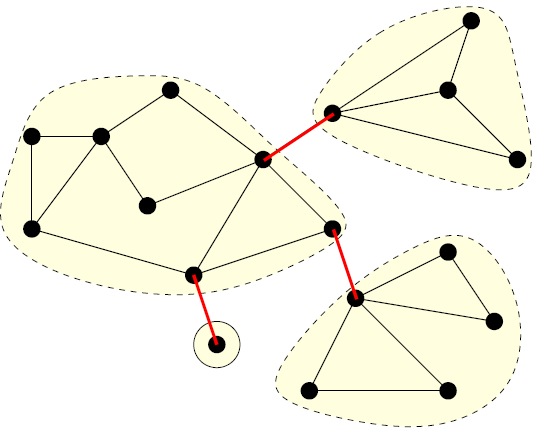
A graph \(G = (V,E)\) is 2-edge-connected if for every two \(u, v ∈ V\) , there are two edge disjoint paths connecting \(u\) and \(v\).
Let \(B\) be the set of bridges in a graph \(G = (V,E)\). Then, every connected component in \((V,E \backslash B)\) is 2-edge-connected. Every such component is called a 2-edge-connected component of \(G\).
Find bridges
It's clear that, if an edge contributes to a circle, it must not be a bridge. Or it is a bridge.
That's to say, a candidate bridge maybe becomes non-bridge, because of certain vertical edge.
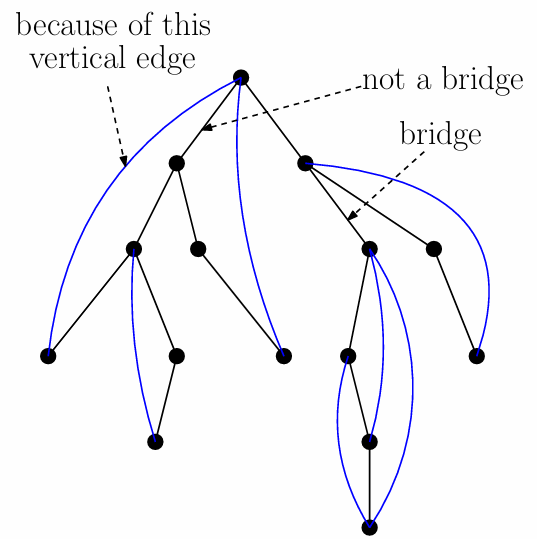
To code the solution, we need to define some values:
- \(v.l\): the level of vertex \(v\) in DFS tree
- \(T_v\): subtree rooted at \(v\)
- \(v.r\): the smallest level that can be reached by a vertical edge from \(T_v\)
- \((parent(u),u)\) is a bridge if and only if \(u.r ≥ u.l\)
- because a certain vertical edge make \((v, u)\) a part of circle
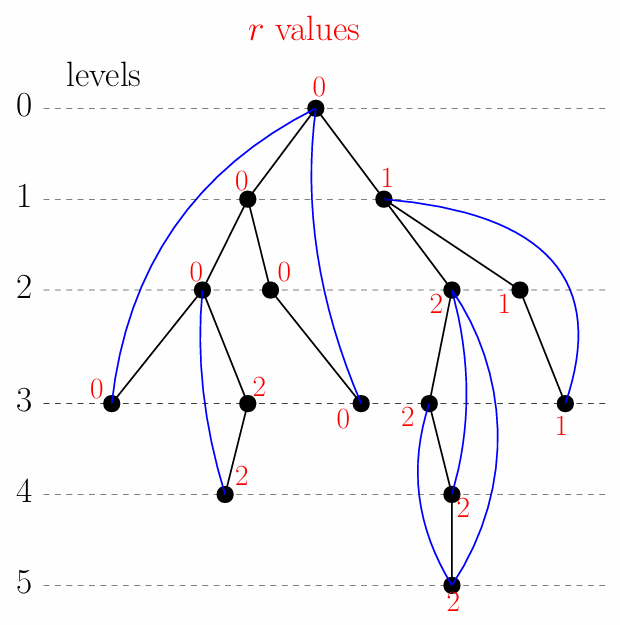
Then give the pseudo-code:
| recursive-DFS | |
|---|---|
1 2 3 4 5 6 7 8 9 10 11 12 13 14 15 16 17 18 19 20 | |
Cut vertex
Vertex version of "bridge".
A vertex is a cut vertex of \(G=(V,E)\) if its removal will increase the number of connected components of \(G\).
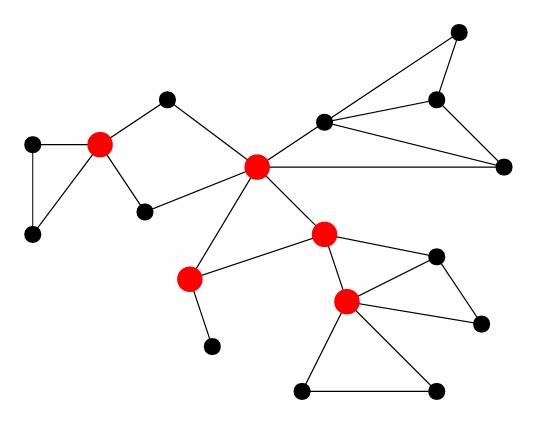
A graph \(G = (V,E)\) is 2-(vertex-)connected (or biconnected) if for every \(u,v ∈ V\) , there are 2 internally-disjoint paths between \(u\) and \(v\).
A graph \(G=(V,E)\) with \(|V| ≥ 3\) does not contain a cut vertex, if and only if it is biconnected.